
The death of Christopher Marlowe has been one of the most intriguing and fascinating mysteries in the history of English literature. According to popular belief, the literary acclaimed poet died at the tender age of 29 in a tavern brawl. But was it just an accident? There are two main conjectures to Marlowe’s death, one that it was a government-aided conspiracy and two that Marlowe faked his own death.
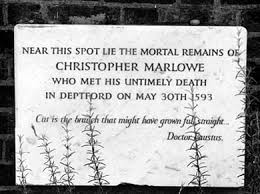
How did Christopher Marlowe die?
Contents
There have been numerous stories surrounding the circumstances of his death. Earlier, it was believed that Marlowe’s death was just an accident but some recent reports suggest that his death might have been a preconceived cold-blooded murder.
According to the official reports of the Public Records Office, London, on 30 May 1593, Marlowe arrived at the lodging house of Dame Eleanor Bull in Deptford. That day he was accompanied by three other men Robert Poley, a government agent, Ingram Frizer, and Nicholas Skeres.
Marlowe and his friends were having a good time smoking and drinking and had their supper. According to witnesses, when the time came to pay the bill, an argument broke out between Marlowe and Frizer. Marlowe grabbed Frizer’s knife and started slashing at him. Frizer in self-defence got hold of the knife and drove the knife through Marlowe’s head just above his right eye. Marlowe died instantly.
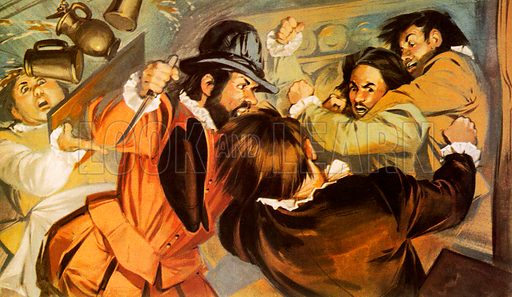
Who killed Christopher Marlowe and why?
Though Marlowe’s death might seem like an accidental tavern brawl, legend says that the accident must have been fabricated to cover up a premeditated murder.
Ingram Frizer the main accused for Marlowe’s death was the business agent of Thomas Walsingham, cousin of Secretary of State. The other two people present in the crime scene Poley and Nicholas were also government agents and they might have devised this whole plan to get rid of Marlowe.
The Conspiracy Theories
Marlowe was a brilliant playwright but apparently, his character was overshadowed with rumours of homosexuality, heresy, and working as a spy for the Queen.
Marlowe was an atheist and a government critic. He was quite vocal about his views and beliefs. Many of the characters of his play like ‘Tamburlaine’ professed atheism and was in direct conflict with the Majesty’s government.
According to some manuscripts recovered from the British Museum, it states that Marlowe discovered the truth about four members of the Privy Council, the supreme authority of the Queen. The four members were William Cecil, Baron Burghley, Robert Cecil, Lord Henry Howard, and Henry Carey, 1st Baron Hunsdon who were involved in acts of heresy which was punishable by death sentence.
Marlowe’s play Edward II clearly challenged the Elizabethan England and was based on this conspiracy of heresy going on in the Privy Council. It was a matter of great shame for the Kingdom and could give rise to political riots.
Marlowe’s knowledge was life-threatening and it was decided to silence him once and for all. Frizer, Skeres, and Poley were asked to carry out the murder and in return was promised immunity. After a short while, they have been cleared off all charges and were granted titles and wealth.
This incident clearly indicates that the Queen of England herself was involved in the conspiracy and gave out the orders. Marlowe was campaigning atheism and his plays were propagating Catholicism which was a threat to the Queen’s authority.
Did Marlowe fake his own death?
Another very interesting theory suggests that Marlowe faked his own death and that the whole incident of his murder was a well-thought-out plan to allow him to escape the country. It was believed that Marlowe has lived for many years and has published his literary work under the name of William Shakespeare.
According to this theory, the Queen herself arranged for Marlowe’s evacuation so that he can evade the death sentence. The three of his accomplices present that day in the housing lodge in Deptford were secret service agents working for the queen and just carrying out her orders. The promptness under which Marlowe’s killers were pardoned and released is doubtful and further supports this theory.
Check out some of Marlowe’s famous monologues
Famous Plays by Christopher Marlowe
Famous poems by Christopher Marlowe
The Inevitable Day Poem by Christopher Marlowe
The Massacre at Paris, Christopher Marlowe Summary
Enter A Spy, The Double Life of Christopher Marlowe
Christopher Marlowe Famous Quotes
Christopher Marlowe Vs William Shakespeare Comparison