
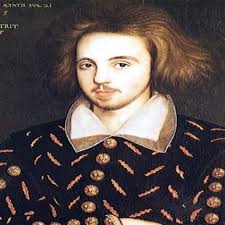
Who was Marlowe?
Christopher Marlowe was a poet and playwright who was at the forefront of the 16th-century dramatic renaissance. His pioneering works such as ‘The Jew of Malta’ and ‘Doctor Faustus‘ influenced William Shakespeare and the later generations of writers.
Christopher Marlowe Birth and Early Life
Christopher Marlowe was born on 26th February 1564 to a shoemaker named John Marlowe and his wife Catherine in Canterbury. The exact date of his birth is not known and 26th February was the day on which he was baptised as is as such considered to be the date of his birth.
He went to King’s School, Canterbury and later on joined Corpus Christi College, Cambridge on a scholarship. He received his Bachelor of Arts degree in 1584. Christopher was an English dramatist, poet and was well-known for his blank verse, he was also regarded as “the father of English tragedy“.
He adopted literature as a profession and became quite attached to Lord Chamberlain’s players. His combination of an inquiring mind and dissolute life led him to be charged with atheism and immorality, and only his sudden death in a tavern brawl enabled him to avoid arrest.
Christopher Marlowe’s Work
Contents
In London, Marlowe joined Lord Admiral’s Company Of Players and started writing plays for the stage. Marlowe was as popular for his work as he was popular for his strong and sometimes agnostic beliefs. His opinions were more often than not considered immoral by the people of his times.
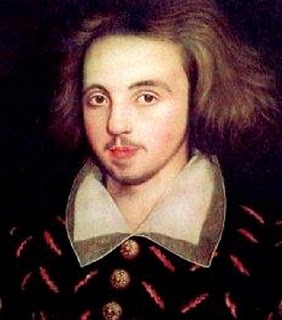
Marlowe’s first drama was Dido, Queen of Carthage and first play that was performed on stage in London was Tamburlaine in 1587. This play is regarded as one of the blank verses. His other plays included works like ‘The Jew of Malta’, ‘Edward the second‘, ‘The Massacre at Paris’, etc.
Christopher Marlowe Beliefs
It was believed that Marlowe was a government spy working under Sir Thomas Walsingham. It was also said that Marlowe tutored Arbella Stuart, niece of Mary, Queen of Scots in 1589 as a part of his spying activity. Arbella was another competitor for the throne after Elizabeth I’s death along with James VI of Scotland.
Christopher Marlowe was an atheist, something that was looked down upon as it was regarded as being God’s enemy. Historians believe that his being an atheist was a false story created to cover up that fact that he was a government spy. Marlowe was even arrested on charges of atheism in 1593.
Another story that revolved about Marlowe was that he was homosexual. It has been said by some scholars that there is evidence of his being gay in his works like Hero and Leander. Marlowe greatly admired and was regarded as an influential artist by his contemporaries.
There are some contemporaries who think that he was the anonymous author of The Return From Parnassus written in 1598. Even Shakespeare had paid a tribute to him through his play As You Like It in which he has quoted a line from Marlowe’s Hero and Leander. Marlowe had a great impact on Shakespeare which is very clear from the fact that Shakespeare in his plays used lines that were there in Marlowe’s plays.
Christopher Marlowe Plays
Edward the Second
Edward the Second is a historical play about the assassination of the King by his Queen and the Barons. He portrayed the Saint Bartholomew’s day massacre in his very vivid work which was named The Massacre at Paris.
‘Edward the Second’ shows the truest sense of theatre of all of his plays. Its plot is skillfully woven, and the material, neatly compressed, shows a great sense of dramatic requirements new in his plays, and, indeed, in English historical drama.
The play has less poetic fervour than some of the others, and its hero is not great enough to be truly tragic, but it works up to a fine climax of deep pathos. In its multiplicity of ‘living’ characters and lack of bombast, it stands apart from other plays.’
The Tragical History of Doctor Faustus
However, his most dangerous play is The Tragical History of Doctor Faustus. This play was based on the German character Faustbuch. Here Marlowe deals with the Faust legend of the devil’s pact.
Dr. Faustus is characterized by his intellect and greed for more knowledge which leads him to make a pact with the devil to sell his soul for a certain period of unparalleled glory and fame. He gets his wish but ends up regretting it and wanting to change it but in the end, he is dragged screaming off to hell.
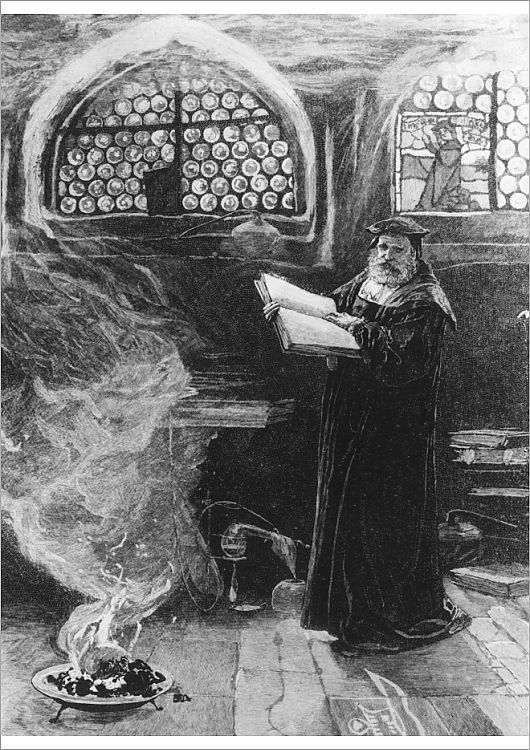
Doctor Faustus’ has a good beginning and a good ending, which is Marlowe’s best play, but scenes that contain comedy are sub-standard and rumoured to have been written by someone else. The play contains some snippets of the so-called miracle plays, in which there are conversations between the Good Angel and the Bad Angel.
This and many of Marlowe’s later works are a challenge for the scholars because they were rewritten after Marlowe’s death. Maybe in his age, Marlowe was considered God’s enemy but it can never be denied that he was a source of great influence to his contemporaries (like Shakespeare) and to this day he continues to influence the literary minds.
Tamburlaine the Great
‘Tamburlaine the Great’ is centred on one inhuman figure, is on a theme essentially undramatic, in that the plot allows no possibility of complication. The play is episodic and lacking any cohesion save the poetic one, but it has some of the best blank verse that Marlowe has ever written. Its sequel is much inferior to that of its predecessor.
It contains still less plot and far more bombast.
Jew of Malta
The ‘Jew of Malta’ has two fine economically handled opening acts, but deteriorates later when the second villain enters the scene. The play is also of interest as showing Marlowe’s attention turning towards the conventional Machiavellian villain.
‘The Tragedy of Dido, Queen of Carthage’ is an inferior piece and ‘The Massacre at Paris’ is unfinished.
Christopher Marlowe Poems
Apart from writing plays, Marlowe was also a poet and wrote some of the most influential poems in English literature. The most prominent poems of Christopher Marlowe include:
- Hero and Leander
- The Passionate Shepherd to His Love
- Lament for Zenocrate
- That face that launched a thousand ships.
Christopher Marlowe: Writing Style
Marlowe’s plays, all tragedies, were written within 5 years (1587-92). He had no bent for comedy, and the comic parts found in some of his plays were always inferior and maybe by other writers. As a dramatist, Marlowe had serious limitations, though it is possible to trace a growing sense of theatre through his plays.
Only in ‘Edward II’ does he understand any element of efficient plot construction. We could slightly neglect his characterization, which is of the simplest method yet lacks humanness, as compared to Shakespeare’s characters.
To appreciate Marlowe properly, we cannot look at him only from a conventional lens of drama and it is almost a crime to view his plays only as representations of the romantic ideals of the time. Each of his plays has the driving force of his vision, which gives an artistic and poetic unity.
Though not the first to use blank verse in English literature, he was the first to exploit its possibilities and make it supreme. His verse is noted for its vivacious energy, its exquisite handling of diction, its variety of speed, and its intertextual relationship with the reader. Full of bold primary colours, his poetry is crammed with imagery from the classics, from astronomy and geography, imagery barbaric in its wealth and splendour. Its resonance and power led Ben Jonson to coin the phrase, ‘Marlowe’s mighty line’.
Marlowe was a part of a group called ‘The University Wits’. These young men, nearly all of whom were associated with Oxford and Cambridge, did much to found the Elizabethan school of drama. They were all more or less, acquainted with each other, and most of them led irregular and stormy lives.
Their plays had many common features such as a fondness for heroic themes, much like Marlowe’s ‘Tamburlaine’. The style of writing was also heroic: splendid descriptions, long swelling speeches, the handling of violent incidents and emotions. These qualities were necessary and added the touch of excellence when used with restraint. The themes were usually tragic, for dramatists were, as a rule, too much in earnest to give heed to ‘lower forms such as comedy’.
Who was Christopher Marlowe influenced by?
Marlowe was deeply influenced by classical writers and thinkers such as Ovid and Virgil. Marlowe himself had ample political connections and was influenced by the philosophies and writings of Nicollo Machiavelli in that respect.
Marlowe’s association with Thomas Kyd and Thomas Watson
In London, Marlowe became acquainted with his fellow playwrights Thomas Kyd and Thomas Watson but the association proved to be troublesome.
In 1589, Marlowe along with Watson got arrested for the murder of William Bradley a notorious thug and was imprisoned in the Newgate Prison. Marlowe was later released after a fortnight.
Marlowe was quite intimate with Thomas Kyd and supported his unorthodox religious views. But this partnership also brought trouble to Marlowe. In 1593, Kyd was arrested at his home for implicating communal riots against Flemish Protestants and some documents of heresy were recovered from his home.
Kyd was arrested and tortured and during his interrogation, he denied the charges of heresy and confessed that the documents belonged to Marlowe and that he has been falsely framed. The Privy Council investigated the matter and immediately ordered for Marlowe’s arrest. At that time Marlowe was in Kent as most of the theatres have been closed down due to the plague that has infected London. Marlowe was instructed to report daily to the Privy Council.
Why is Marlowe called the Father of English Tragedy?
Marlowe is known as the Father of English Tragedy because it was he who first perceived the greatness hidden in the form of romantic drama. He composed all his plays in blank verse and popularised it. His language was extraordinary, infusing terror, pain and fear in the minds of the audience.
Hid characters were complex and possessed a certain depth that was missing from the plays of most of his contemporary playwrights. His verse style was not only high-sounding but also elegant. Hence, the elements of tragic drama were chiselled, polished and presented by Marlowe through plays like Doctor Faustus and Tamburlaine.
Shakespeare’s language and style were deeply influenced by those of Christopher Marlowe.
Christopher Marlowe’s Arrest & Death
The constant rumours of his atheism got him arrested for just that “crime.” Atheism was a serious offence for which the punishment was that the person would be burned at stake. However, he was not jailed or tortured but he was released on the condition that he would report daily to an officer of the court.
How did Marlowe die?
Marlowe’s death is regarded as a tragedy. There is ambiguity about the exact events which lead to his untimely death but it was generally stated that he was killed by Ingram Frizer who also worked for Sir Thomas Walsingham. It was said that Marlowe, along with Frizer, Nicholas Skeres and Robert Poley spent all day together in a house in Deptford.
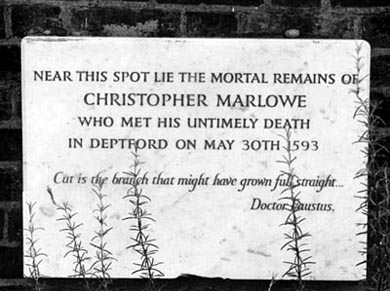
All these men were working for Walsingham. Marlowe and Frizer had a small fight before this major incidence about payment of a bill. However, after some time when Frizer was sitting on a table, Marlowe allegedly attacked Frizer first by snatching Frizer’s dagger.
Frazer, accidentally in the heat of the moment stabbed Marlowe just above the right eye, killing him instantly. His body was later on buried in an unmarked in the churchyard of St. Nicholas, Deptford. When this matter was heard by the jury, it concluded that Frizer acted in self-defence which led him to stab Marlowe in a fatal manner.
The version on the death of Marlowe given by Sir Sidney Lee that Marlowe was killed in a drunken fight is till date considered to be the facts which resulted in the death of Marlowe. However, there were some authors Daryl Pinksen, Rodney Bolt, Roderick L Eagle amongst many others who believed that Marlowe had faked his death and he continued writing plays under the adopted name of William Shakespeare. Another speculation was that his death was actually an assassination.
There have been numerous conspiracy theories regarding the reason of Marlowe’s death. Some say that it was a result of Marlowe’s spying activities for the queen, some say it was his atheism.
Marlowe during his life had been good friends with eminent personalities like Sir Walter Raleigh. Marlowe’s career barely lasted for four or six years between 1587 and 1593, when he was murdered. At the time of his death, Marlowe was just 29 years old.
In 1589, there was a charge against Marlowe for murdering William Bradley but was later on acquitted. Again in 1592, an injunction was brought against him for the death of a man resulting from a street fight. Thus ended the life and career of the man who had been a source of inspiration for future writers.
Even though Marlowe wrote only two plays that gained fame, these two plays placed him as an important predecessor to Shakespeare and second only in the importance as a tragic playwright.
Check out some of Marlowe’s famous monologues
Famous Plays by Christopher Marlowe
Famous poems by Christopher Marlowe
The Inevitable Day Poem by Christopher Marlowe
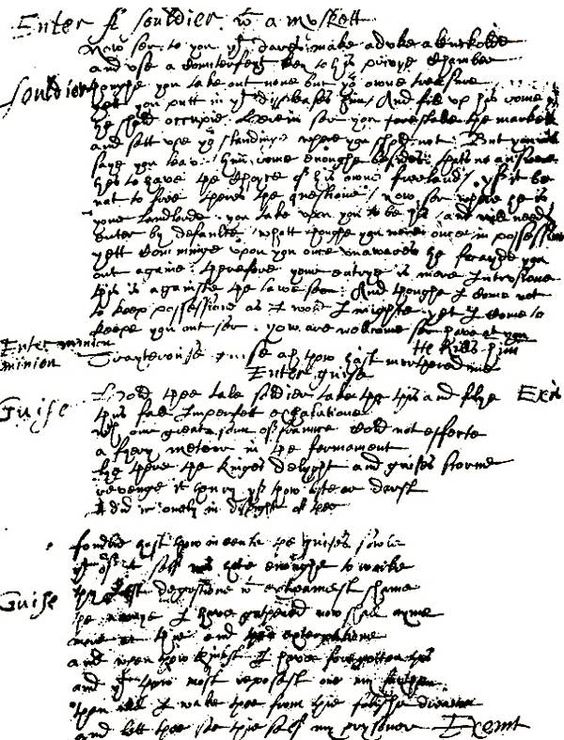
The Massacre at Paris, Christopher Marlowe Summary
Enter A Spy, The Double Life of Christopher Marlowe